The October 27 exchange turns on which rule justified the first warning and how it was applied. This report compares the recorded sequence with the signed comment policy, Council’s financial-oversight powers and other speakers’ treatment. The full case file preserves the evidence, legal references and unresolved questions.
Government
Jones interrupts Shabazz over spending criticism. What do Council’s rules allow?
Mayor Phillip Jones interrupted BeKura Waliah Shabazz during October 27 spending criticism. Council’s rules, oversight powers and treatment of other speakers put that warning in context.
Story details
At a glance
- Jones first intervened after Shabazz raised the Council handbook and City credit-card spending. Her later Phillip and homie remarks followed that warning. [S1]
- The signed policy distinguishes personal insults from substantive remarks; the charter and handbook give Council spending-oversight powers. [S2; S4; S5]
- Shabazz continued and concluded with thanks. Other speakers also criticized named officials, limiting a blanket claim that only praise was permitted. [S1]
In brief
Full report
BeKura Waliah Shabazz was raising concerns about City credit-card spending when Mayor Phillip Jones interrupted her at Newport News City Council’s October 27 meeting. He invoked how speakers address Councilmembers and whether the subject was something Council could address. [S1]
The exchange raises a specific question: which rule justified that first interruption? Council’s adopted comment policy distinguishes substantive remarks from personal insults. Its charter and handbook also give Council responsibilities for examining public spending. [S2; S4; S5]
The recording warrants scrutiny of that boundary. It also contains evidence that limits a broader claim that Council permitted praise but prohibited criticism.
WHAT HAPPENED
Shabazz’s turn begins at approximately 1:08:40 in the official Newport News Television Facebook broadcast. She criticizes Council’s performance and speaks about integrity and the appearance of impropriety before referring to Cleon, the Council handbook and the City’s credit card. [S1]
Jones first intervenes at about 1:09:54. Audit Newport News’s automatic working transcript renders the central instruction as “we’re not addressing members of Council.” Some surrounding and overlapping words remain uncertain. The recording, rather than the working text, controls disputed wording. [S1]
Shabazz asks that her time be stopped because of the interruption; Jones declines. A further warning concerns being asked to stop. Her later remarks addressing Phillip and using homie come after the first intervention. That order matters when evaluating the reason for the first warning, while her complete opening and the instructions given before public comment remain relevant. [S1]
She continues speaking and concludes with thanks at approximately 1:10:59. The reviewed record does not establish that she was removed, that her microphone was cut off or that the three-minute limit was enforced against her. Her elapsed turn does not prove how the timer operated, whether she lost prepared remarks or why she finished. [S1]
WHAT THE WRITTEN POLICY SAYS
Council adopted Resolution 13822-25 on February 11, 2025. Its attached public-comment policy expressly supplements City Code sections 2-36(c) and 2-64; the resolution is not the entire set of meeting rules. [S2; S3]
Paragraphs 3–5 limit comments to matters within Council’s authority, require speakers to identify Council’s interest or an action they want it to take, and establish three-minute turns. Paragraph 7 directs remarks to the Mayor and Council rather than to the audience. It does not expressly impose a blanket prohibition on naming a Councilmember. [S2]
Paragraph 8 defines a personal attack around insulting a person rather than addressing substantive ideas or procedures. Paragraph 9 says members generally listen during citizen comments but may respond. Paragraph 12 provides enforcement measures for violations and disorder. The policy therefore requires examining the subject and conduct of a particular turn; naming an official, criticizing official spending and disrupting a meeting are different acts. [S2]
A legal assessment must also account for reasonable, viewpoint-neutral meeting rules. In Steinburg v. Chesterfield County Planning Commission, the Fourth Circuit upheld restrictions and enforcement in the circumstances before it, including a reasonable perception of disruption. That decision supplies a standard to examine; it is not a ruling on Shabazz’s exchange. [S6]
The preserved signed 2025 policy and public codifier provide the rule framework reviewed here. A complete record of any amendments and the instructions actually in force on October 27 is still needed before declaring precisely how every provision applied. [S2; S3]
COUNCIL HAS SPENDING-OVERSIGHT POWERS
The City Charter gives Council power to inquire into the official conduct of offices or officers under its control and to investigate City employee accounts and expenses. Section 4.02(C) also permits Council or the City Manager to order an examination or audit of an officer’s or department’s accounts. [S4]
The Council handbook adds a more specific connection. Its expenditure-oversight provision calls for quarterly reporting that includes purchasing-card spending, with apparent concerns reviewed by Council as a body. [S5]
These provisions support asking how Shabazz’s spending criticism fell outside Council’s business. They do not establish that her underlying financial accusation was true, compel Council to accept an allegation or turn a public-comment period into a criminal trial.
The distinction leaves a concrete reporting question: was the warning directed at an irrelevant subject, a personal insult, how she addressed members, perceived disruption or some combination? Those reasons require different comparisons with the written rules and other speakers.
WHAT THE REST OF THE MEETING SHOWS
Earlier speakers name officials and address members directly. The recording includes praise of officials around 44:29 and a direct address to Councilman John R. Eley III in a brief request for later contact around 56:58. These passages test a literal member-address restriction, while their different substance and manner limit comparisons involving personal insults. [S1]
The recording also contains later criticism. The next speaker mentions Jones while criticizing camera procurement at about 1:11:34. Another speaker names Councilman Curtis Bethany in criticism of a privacy follow-up at about 1:23:56, several speakers later. The reviewed passages show those criticisms continuing without the same warning. [S1]
That evidence does not resolve why Shabazz was interrupted. It does rule out a simple account in which every critical remark or every use of an official’s name was stopped. A fair comparison must consider the actual words, context, preceding instructions and conduct.
WHAT REMAINS TO BE ESTABLISHED
The most useful next records are specific: the operative meeting instructions; any retained speaker-registration entry or written remarks; available timer records; and native footage sufficient to assess the complete sequence. Shabazz’s account of what she intended to say, and the City’s explanation of the rule being enforced, would also help resolve the dispute.
The public records reviewed through October 29 do not answer those questions. The missing information could clarify the rule being applied, how the clock operated and whether Shabazz intended to ask Council for a particular action. Its absence from this review does not establish withholding or destruction.
No court finding that Shabazz’s rights were violated, and no lawsuit filed on her behalf, is established by this reporting. Her financial criticism remains her allegation. The documented accountability question is whether the first warning rested on a rule that fit her conduct and was applied consistently.
References 6
- [S1] Official October 27 Council broadcast and working transcriptionSource currently unavailable.
All playback positions in this report refer to the Facebook broadcast, not YouTube or Swagit. Shabazz: approximately 1:08:40–1:10:59; first warning around 1:09:54. Comparisons: approximately 44:29, 56:58, 1:11:34 and 1:23:56. The excerpt and automatic transcript derive from the same recording and are not independent corroboration.
- Full official Facebook broadcast
- Excerpt and source notes Source currently unavailable.
- Automatic working transcript and uncertainty notes Source currently unavailable.
- Additional official Swagit edition — separate playback clock
- [S2] Signed Resolution 13822-25 — public-comment policySource currently unavailable.
Adopted February 11, 2025. Physical PDF p. 2: paragraphs 3–5, relevance and time; p. 3: paragraphs 7–9 and 12, address, personal attacks, responses and enforcement; p. 4 continues paragraph 12. The signed copy does not certify the absence of later amendments.
- Preserved signed policy — page 3 Source currently unavailable.
- City-posted resolution PDF
- [S3] Newport News Code — Council procedure and public participationSource currently unavailable.
Sections 2-36(c), 2-52 and 2-64(b)(4)–(6), read with the 2025 policy. The public codifier is not certification of a complete event-date rule history. Councilmember debate rules are distinct from rules governing public speakers.
- [S4] Newport News Charter — investigative and audit powersSource currently unavailable.
Section 4.02(A), official-conduct/account inquiries, and 4.02(C), examinations and audits. These establish powers, not financial misconduct or a duty to grant a particular request.
- [S5] Council handbook — oversight of Council expendituresSource currently unavailable.
Adopted February 25, 2025. Physical PDF p. 41, printed p. 39: quarterly expenditure reporting, including purchasing cards, and review of apparent concerns by Council as a body.
- [S6] Steinburg v. Chesterfield County Planning CommissionSource currently unavailable.
527 F.3d 377, 384–90 (4th Cir. 2008); physical PDF pp. 12–20. Controlling circuit-law context concerning neutral meeting rules and reasonably perceived disruption; not a finding about Newport News.
Publication notes
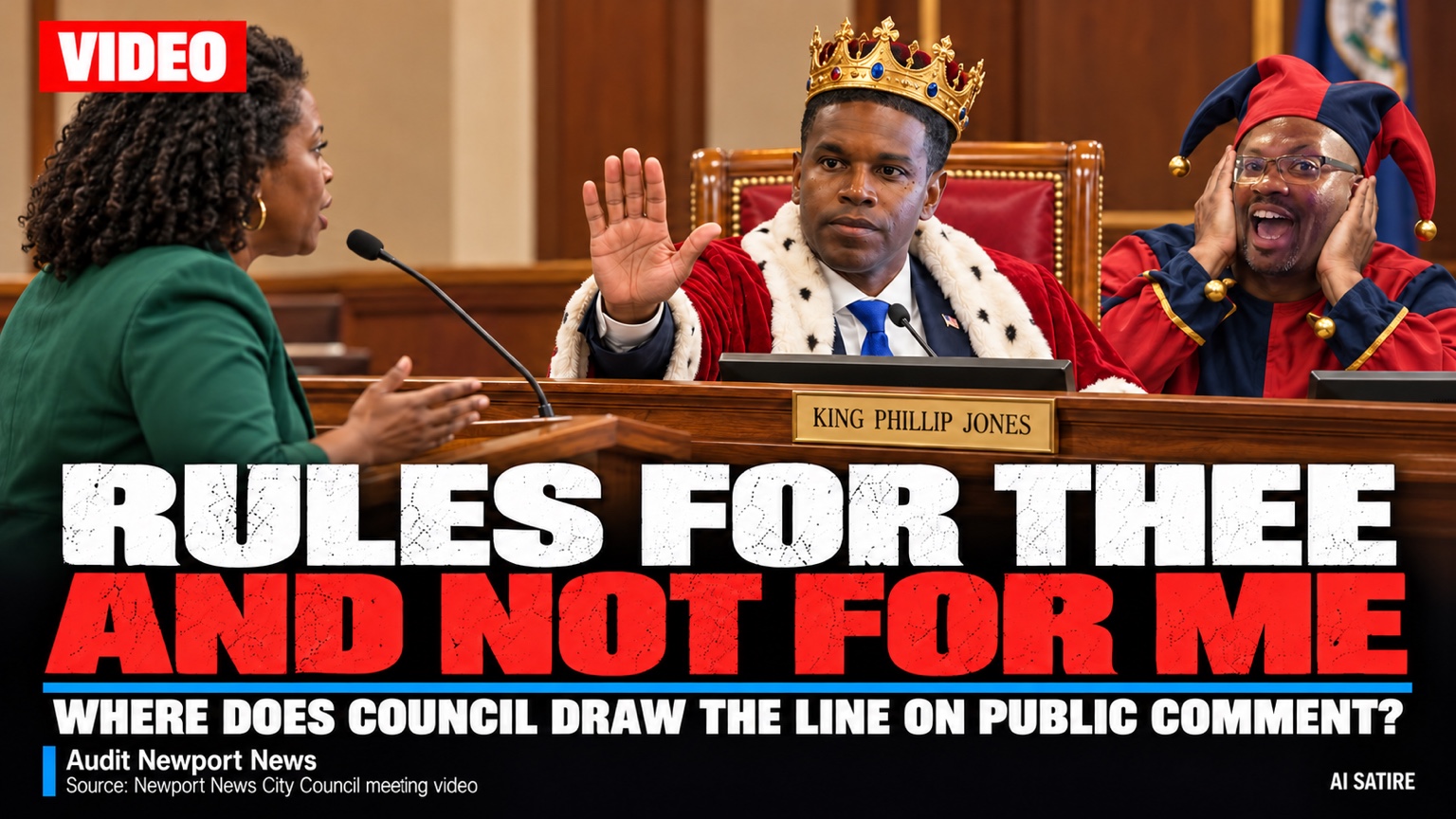
Published October 29, 2026. Public-record reporting and analysis based on the official meeting broadcast and the documents cited here. The transcript is automatic working text with uncertain passages. This report includes no post-event interviews. The cover is AI-generated satire supplied by Audit Newport News; the separate video is an excerpt of the actual broadcast.