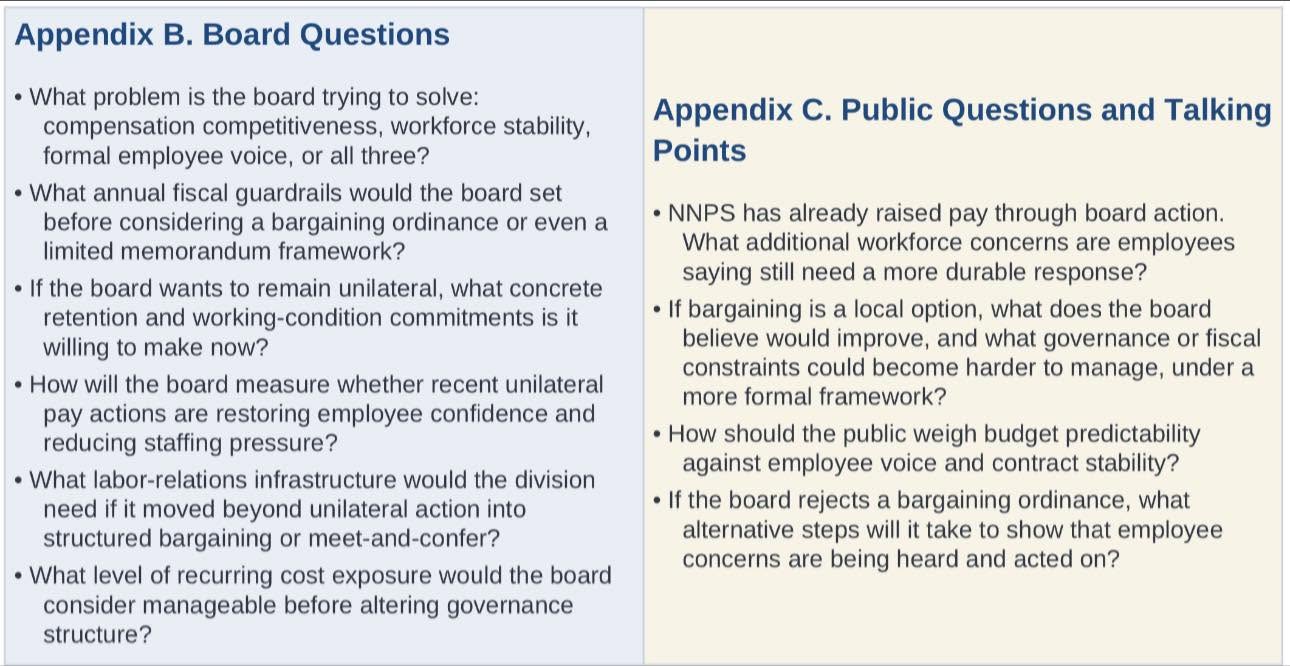
The collective-bargaining discussion in Newport News Public Schools should begin with the workforce problem the division intends to solve. Competitive pay, dependable staffing, employee trust and a durable way to address working conditions are related goals, but they require different evidence.
The March 17, 2026 commentary asked the School Board and public to examine those goals before reducing the issue to a yes-or-no slogan. It also asked what concrete commitments the board would make if it continued acting unilaterally. [1]
This article is an evaluation framework. It does not report that NNPS adopted a bargaining ordinance, signed an agreement or changed its labor arrangements. The proposals and measures below are questions to answer, rather than descriptions of a new policy.
DEFINE THE PROBLEM BEFORE CHOOSING THE ARRANGEMENT
The first question is what employees need a more durable response to: compensation competitiveness, recruitment, retention, working conditions, formal voice or a combination.
A pay action can change compensation without resolving every concern about workload or how decisions are made. Conversely, a proposed labor framework should identify which problem it could address instead of treating its adoption as the outcome itself.
The board should set out the evidence behind its priorities. Useful measures would include vacancies by role, hiring and departures, time to fill positions and attributable employee feedback. A divisionwide figure can hide different pressures among teachers, support staff and other employees.
Those are proposed measures, not findings about NNPS’s current vacancy or departure rates. The commentary does not supply a dataset establishing the size or cause of each workforce problem.
MAKE COMPENSATION COMPARISONS USEFUL
The original discussion acknowledged pay increases through board action. The next question is how the division will evaluate whether those actions improved competitiveness and staffing.
A single percentage increase cannot describe every employee’s compensation. A useful comparison would identify the affected positions, salary schedules, experience levels and recurring cost, along with benefits or conditions relevant to the proposal.
The comparison should also distinguish approved positions from filled positions. Funding a position and having someone available to deliver the service are different results.
Budget documents provide a starting point for those discussions. They establish authorized financial plans, rather than proving what employees experienced or whether a particular staffing problem was resolved. The existing School Board approved budget is linked as context. [2]
Residents should be able to connect a proposed workforce investment to the roles affected and the result the division expects, whether that investment is negotiated or approved unilaterally.
EXPLAIN RECURRING COSTS AND THE ALTERNATIVES
The board should identify the annual fiscal guardrails it would use before considering a formal arrangement. Those guardrails should address recurring commitments and the assumptions used to fund them.
The important comparison is among plausible choices. What would the division spend under continued unilateral action? What additional commitments could a proposed agreement create? Which costs depend on future staffing, compensation or administration?
This article does not supply a bargaining cost estimate. It asks for one that separates known amounts from assumptions and identifies the time period covered.
A useful presentation would show the first-year amount, later recurring exposure and what happens if revenue or staffing assumptions change. It would also explain which decisions remain with the board and what process a proposal would establish.
Budget predictability and employee confidence both deserve consideration. A cost warning needs a stated basis, just as a promised retention benefit needs a method for measuring it.
GIVE EMPLOYEE VOICE A PRACTICAL MEANING
“Employee voice” should describe a process employees can understand. Who represents a concern? How is it recorded? Who must respond? What happens when a problem remains unresolved?
If the board considers a more formal framework, it should explain the administrative infrastructure needed: staff responsibilities, meeting procedures, documentation and a way to handle disputes.
Those are implementation questions, rather than proof that an arrangement would succeed or fail. The existence of a formal process cannot establish that employees trust it, while the absence of a bargaining agreement does not establish that employees have no existing avenues to speak.
The board can evaluate how current channels operate and whether employees believe concerns receive a timely, meaningful response. Report the findings in a way that protects individual personnel information.
A framework should be judged by its actual access and follow-through, not solely by the name given to it.
WHAT IF THE BOARD KEEPS UNILATERAL ACTION?
Rejecting a bargaining proposal would leave the original workforce questions to answer. The board should identify the alternative commitments it is prepared to make.
Those could be evaluated through a published compensation timetable, a method for reviewing working conditions, a regular employee-feedback process and specific staffing goals. They are options for consideration, not promises this article attributes to NNPS.
Each commitment needs a responsible office, a review date and a measure of delivery. Employees should be able to tell whether an issue was resolved, deferred or rejected, and why.
The same standard should apply to a formal agreement. Choosing a different governance process should not reduce the need to explain its cost or demonstrate its results.
A CLEAR WAY TO EVALUATE OUTCOMES
Recruitment, retention and trust should be assessed over a defined period. The board can identify a baseline, announce the actions taken and report the later comparison.
A change in vacancies does not by itself establish why it occurred. Hiring cycles, departures and other circumstances may also matter. The explanation should distinguish a measured outcome from a claimed cause.
Employee feedback likewise needs context: who was invited, how participation worked and whether the findings represent a broad workforce or a self-selected group. Protecting confidentiality can help employees participate candidly without presenting individual accounts as a divisionwide finding.
The purpose is to make workforce policy reviewable. If an action does not produce the expected result, residents and employees should be able to see what the division learned and what it changed.
QUESTIONS FOR THE BOARD’S PUBLIC RESPONSE
The original commentary directed questions to Terri Best, Maritsa Alger, Rebecca Aman, Douglas Brown, Rasheena Harris, Gary Hunter and Lisa Surles-Law, with the board clerk as a contact route. Naming those governance roles does not establish that each member supported a particular proposal.
A useful board response would state the problem, compare the available approaches, explain costs and responsibilities, identify an implementation timetable and specify how results will be reported.
Residents and employees can request that explanation in writing and ask when it will return for public review. Supporting records and attributable experiences can help define the issue; private personnel details should stay out of public comments.
The goal is a durable workforce strategy that residents can evaluate through staffing, services, costs and employee confidence. The choice of arrangement deserves scrutiny, and so does the evidence that follows it.